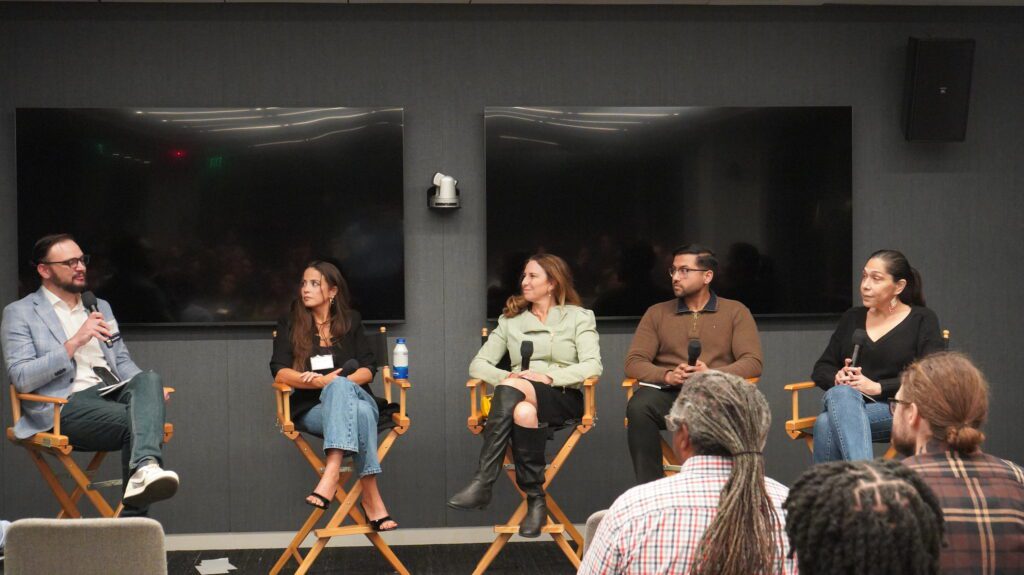
At our Workforce of the Future panel last month, we brought together an extraordinary group of thinkers and practitioners who are actively shaping what the next era of work will look like. Our speakers included Joanna Popper, Chief Executive Officer of Laurel Beach LLC; Ana Pompa Alarcón, Chief Executive Officer of Founders Registry Inc.; Faizan Hussain, Senior Software Engineer at The Walt Disney Company; and Monica Monique, Founder of Chain Reaction. Each person brought a unique perspective, touching on entrepreneurship, technology, workforce development, equity, and the real-life experience of building teams and adapting to rapid change in an AI-enabled world.
Together, they unpacked one of the most urgent questions facing organizations today: How will rapid advances in artificial intelligence reshape not only the skills we need, but the systems, norms, and power structures we’ve long accepted as “normal”?
Our panelists dug into the cultural, economic, and relational shifts already unfolding — from the changing nature of soft skills, to how AI is challenging traditional pathways to opportunity, to the ways founders, creators, and early-career professionals must reimagine their roles. A few themes emerged clearly:
AI Is Reshaping Soft Skills, Not Replacing Them
One of the strongest messages from the panel was that AI is not replacing human qualities. It is making them more important. Tools can speed up tasks, create drafts, and organize information, but they cannot build trust or create meaningful relationships.
Skills like humility, empathy, curiosity, and kindness are now essential. They shape how teams communicate, how leaders guide others, and how organizations work through uncertainty. Humility, empathy, and kindness remain differentiators in a world where AI can streamline tasks but cannot replace genuine human connection.
AI as an Equalizer and System-Changer
A powerful part of the conversation focused on equity and access. Ana spoke about how certain systems and beliefs have historically limited who gets to participate in entrepreneurship and leadership. When she works with founders who come from communities that have been overlooked or excluded, she often sees how jargon, insider language, and unspoken rules can become barriers. These founders may have strong ideas and real potential, but they are not always given the same access to the vocabulary or frameworks that others take for granted.
To support them, she encourages her founders to keep tools like ChatGPT open during meetings. If something comes up that they do not understand, they can quickly look it up, translate it, or get a clearer explanation in real time. Instead of falling behind in the conversation, they can stay engaged and confident. This simple shift helps remove the pressure of having to already know everything before entering the room.
Ana connected this to a larger pattern she has seen throughout her work. Many people were taught that relying on tools, whether calculators in school or AI today, is a form of cheating. These beliefs have often held communities of color back by making people feel ashamed for using resources that could actually help them advance.
Ana challenged us to rethink this mindset, saying, “We must really embrace AI and understand it’s going to open doors and tear down systems meant to gatekeep.” She reminded us that AI can expand access when we use it with intention. It can help level the playing field by giving more people the information, clarity, and support they need to participate fully. Instead of seeing this moment as something to fear, she encouraged us to consider how these tools can help more people grow, contribute, and succeed.
Efficiency Creates More Demand
In response to the fear that AI will eliminate jobs, Faizan offered a very different perspective. He introduced the idea behind Jevons Paradox, which explains that when something becomes more efficient, we often end up wanting or producing more of it. It comes from economist William Stanley Jevons, who observed in the 1800s that when steam engine technology became more efficient and used less coal, coal consumption actually went up, because people started using steam engines in many more places. AI is creating this exact effect in the workplace.
He described how the team he is now part of did not exist a few years ago and only exists because of AI. Before these tools were available, the amount of work needed to build the products they work on would have required too much time, too many people, and far more financial resources. It simply would not have been realistic or cost-effective. AI changed that. By speeding up processes like research, prototyping, and decision-making, it made the work achievable. The efficiency opened the door for entirely new roles, new projects, and new possibilities. Instead of replacing jobs, AI created the conditions for jobs that were not possible before.
Faizan’s example showed that the future of work is not about shrinking teams. It is about expanding what teams can do.
Learning About AI Is No Longer Optional
Joanna offered a clear reminder about what it means to stay prepared in a changing workplace. She explained that using AI may be a personal choice, but learning about it is not. Every industry is being shaped by these tools, and staying informed is now a basic part of being prepared for the future of work.
She encouraged people to start with understanding the tools that already exist in their own organizations and fields. You do not need to be an expert or a technologist. You only need enough awareness to make smart decisions, ask better questions, and recognize what these tools can and cannot do. Ignoring AI will not protect you from it. Learning about it, even in small ways, is what keeps you adaptable and ready for what comes next.
Professional Visibility Matters More Than Ever
In a world where AI can speed up productivity, your presence and voice still matter. The panel emphasized the importance of showing up online, especially for early career professionals and founders. LinkedIn has become a key place to build relationships, share ideas, and create opportunities. Monica put it simply: if you are not engaging on LinkedIn as if the people there are your community, you are missing a major opportunity.
This idea connects to a larger theme from the conversation. The future of work will reward people who stay curious, who build real relationships, and who use technology with intention. AI is not here to remove the human workforce. It is here to change how we work and to open new paths for those who are willing to adapt.
The workforce of the future will not be defined by machines. It will be defined by people who know how to work alongside technology with confidence, empathy, and creativity.
Thank you again to our speakers, our moderator Charles Sims, and Sony Pictures Entertainment for hosting, and to everyone who joined us for this conversation. The workforce of the future is unfolding in real time, and together we are supporting scholars who will be better prepared to meet it.